The Shore Hardness Scale
The Shore Hardness Scale is the international standard for measuring the hardness of rubber, plastic, and many non-metallic materials. Hardness, typically measured on a Shore A or D scale in our industry, is a material’s resistance to surface penetration. Knowing a material’s Durometer is a great place to start when trying to choose the right material for a certain application. BJB classifies many of its products based on the Durometer scale so it’s important to understand the differences.
How Do You Measure a Material’s Hardness?
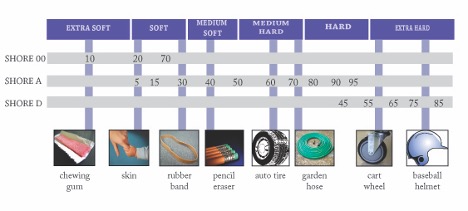
The shore hardness tests are performed by creating an indentation on the plastic or rubber with a gauge called a Durometer. The Durometer is pressed down on the sample perpendicularly and a spring-loaded presser-foot makes contact with the sample. The gauge measures the resistance of the sample as it deforms. The A and D Scale use different shaped presser-foots and spring tensions because softer materials will deform easier than harder materials. The tip of the Shore A presser is more blunt and has a softer spring, while the Shore D presser foot has a more pointed tip and firmer spring. The higher the number, the higher a material’s hardness is on that scale. Gel like materials are measured on the Double Ott (OO) scale. The scales can cross over (see chart above) so we use the most appropriate Durometer style depending on the material being measured. The sharp presser foot of the Shore D Durometer would pierce the surface of a 70, 80, or 90 Shore A rubber and give a false reading, so we don’t use it on those materials.