Polyurethane

What Is the Shore Hardness Scale?

Home  |  How-to articles  |  Polyurethanes

The Shore Hardness Scale

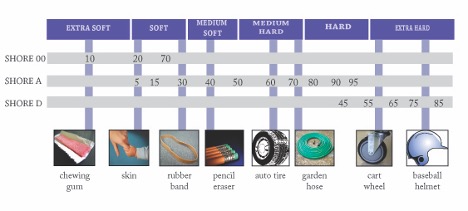
The Shore Hardness Scale is the international standard for measuring the hardness of rubber, plastic, and many non-metallic materials. Hardness, typically measured on a Shore A or D scale in our industry, is a material’s resistance to surface penetration. Knowing a material’s Durometer is a great place to start when trying to choose the right material for a certain application. BJB classifies many of its products based on the Durometer scale so it’s important to understand the differences.
How Do You Measure a Material’s Hardness?

The shore hardness tests are performed by creating an indentation on the plastic or rubber with a gauge called a Durometer. The Durometer is pressed down on the sample perpendicularly and a spring-loaded presser-foot makes contact with the sample. The gauge measures the resistance of the sample as it deforms. The A and D Scale use different shaped presser-foots and spring tensions because softer materials will deform easier than harder materials. The tip of the Shore A presser is more blunt and has a softer spring, while the Shore D presser foot has a more pointed tip and firmer spring. The higher the number, the higher a material’s hardness is on that scale. Gel like materials are measured on the Double Ott (OO) scale. The scales can cross over (see chart above) so we use the most appropriate Durometer style depending on the material being measured. The sharp presser foot of the Shore D Durometer would pierce the surface of a 70, 80, or 90 Shore A rubber and give a false reading, so we don’t use it on those materials.

Why Does the Shore Hardness Scale Matter?

When planning a project, it’s important to understand the function of the plastic or rubber you’ll be using. Soft rubber flooring or an automotive bushing requires some “give,” and the Shore Hardness Scale will provide a measurement to indicate its flexibility or how it will distort and conform to another surface. In some applications, you’ll need rigid plastic for a load-bearing application like an electronic housing or a semi-rigid for a high impact part. Knowing the Durometer Scale can provide a base line to compare materials and understand some of the characteristics required in a material for your application.

As always, you can reach out to our knowledgeable Tech Team if you have any questions with a topic like this. Navigating Durometer can be confusing if you are new to these materials. You can contact us at: 714-734-8450 or info@bjbenterprises.com

Related how-to articles
Polyurethane
January 16, 2023

What Is the Shore Hardness Scale?

The shore hardness tests are performed by creating an indentation on the…
Polyurethane
January 16, 2023

Redesigning Parts for the Process

Most plastic parts are designed for the injection molding process, facilitating long…
Related video learning
Polyurethanes
January 13, 2023

Casting a Part With Polyurethane | Part 2

Welcome to Part 2 of BJB's Mold and Part Making Video Series!…
Polyurethanes
January 13, 2023

How to Care and Store Casting Urethane Materials

BJB Introduces its latest line of high performance flexible polyurethane elastomers. The…
Polyurethanes
January 13, 2023

Pro Series Silicone Mold Tutorial | Electric Skateboard Controller

Watch how to turn high quality SLA 3D Prints into Patterns for…

Leave a Reply